
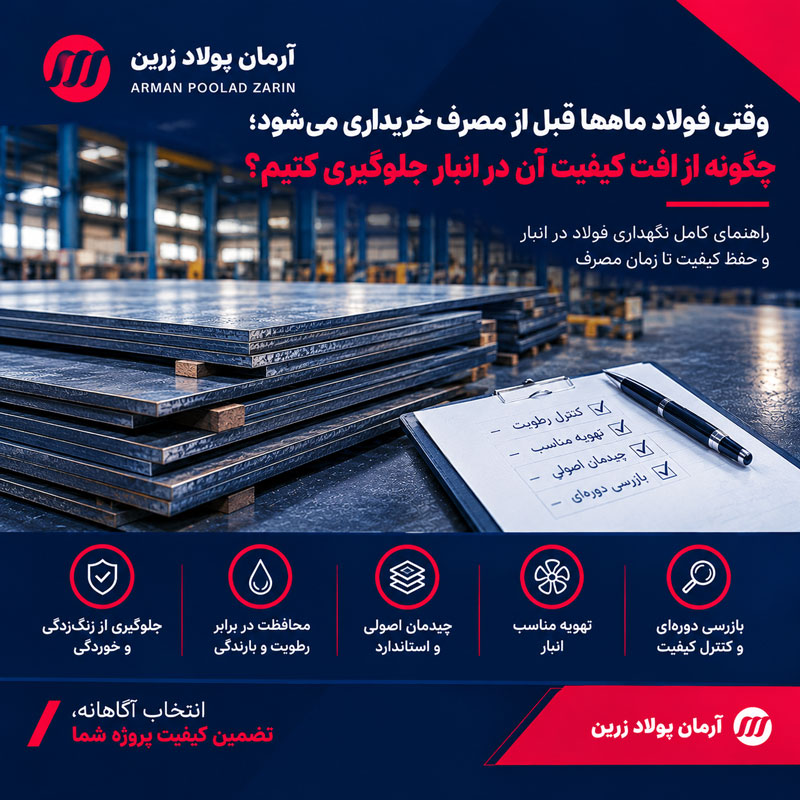
What happens to steel when it is purchased months before use?
Steel products are usually purchased for use in construction or industrial projects, yet the purchased material does not always immediately enter the production or implementation phase.
At times, steel sheets, rebar, or alloy steels remain in storage for weeks or even months.
During this period, storage conditions can affect the product’s appearance, surface quality, and, in some cases, its usability.
For this reason, storing steel involves more than simply placing the product in a covered area; it requires a plan addressing humidity, ventilation, ground contact, stacking methods, and periodic inspections.
Why does steel rust in storage?
Iron and many carbon steels are prone to oxidation when exposed to moisture and oxygen. Consequently, humid environments can accelerate the rusting process.
This is particularly critical for products that remain in storage for extended periods.
It is important to note that precipitation is not the only cause of the problem.
Atmospheric humidity, water vapor, damp flooring, condensation, and poor ventilation can also create conditions conducive to corrosion.
Therefore, even in a fully roofed warehouse, corrosion can occur if humidity is not properly managed.
Does surface rust mean the steel sheet is ruined?
Not necessarily.
The severity and depth of the corrosion are crucial factors.
If the changes are limited to the surface, it may be possible—following an inspection and provided conditions are suitable—to clean and utilize the product.
However, the situation is entirely different if the corrosion has penetrated deeply, causing a reduction in thickness or surface pitting.
That is why, when storing steel sheets, one should not rely solely on the product’s appearance at the time of purchase; Rather, it is advisable to monitor its condition throughout the storage period.
The first mistake in steel storage: direct contact with the ground
One of the simplest measures to help protect steel products is preventing direct contact with the ground surface.
Placing steel sheets or sections directly onto a damp surface can accelerate moisture transfer to the product.
Using supports, pallets, timber, or appropriate equipment to create clearance from the floor facilitates air circulation and minimizes the product’s contact with moisture.
Naturally, the supports used must be capable of bearing the product’s weight without causing bending or deformation.
Why is warehouse ventilation important?
One might assume that a completely sealed warehouse is the ideal place for storing steel.
However, if there is inadequate air circulation within the warehouse, rising humidity and condensation can become problematic.
Therefore, steel storage requires striking a balance between protecting the product from precipitation and ensuring proper ventilation.
The goal is not to expose the product entirely to the outside air, but rather to control the humidity levels within the storage environment.
Is completely covering steel with plastic always the right approach?
No.
While covering the product can offer protection against dust and certain environmental factors, trapping moisture between the covering and the steel surface can actually exacerbate corrosion.
For this reason, the method of covering the product requires careful consideration when storing steel sheets.
The protective covering should not create a humid environment with stagnant air around the steel.
How can steel sheets be stored for longer periods?
To store steel sheets effectively, it is best to observe a few simple principles:
- Ensure a dry storage location
The storage area should be kept as free as possible from water, moisture, and the accumulation of water vapor.
- Do not place sheets directly on the ground.
Maintaining an appropriate gap between the sheets and the warehouse floor can reduce contact with moisture.
- Ensure air circulation.
Proper ventilation prevents moisture accumulation in the environment.
- Periodically inspect the product’s condition.
If the product is to be stored for an extended period, it is advisable to check its surface condition at regular intervals.
- Properly segregate different products.
Grade, thickness, dimensions, and product type should be arranged in a clearly identifiable manner to minimize the risk of errors during retrieval.
Is the storage method for alloy steel the same as for standard steel sheets?
Not necessarily.
Factors such as steel type, chemical composition, surface condition, storage environment, and duration of storage can influence the choice of the appropriate protection method.
For instance, some steel products are manufactured for specific applications and may require different storage specifications.
Therefore, when purchasing alloy steel or specialized products, it is best to obtain the recommended storage conditions from the supplier or manufacturer.
Why is the arrangement of steel in the warehouse important?
Warehousing involves more than just preventing rust.
Improper arrangement can lead to:
Difficult access to the product
Increased handling time
Damage to sheet edges
Deformation of certain products
Errors in identifying grade or dimensions
Increased risk of accidents during handling
For this reason, in a professional warehouse, products must be easily identifiable and accessible, in addition to being protected against environmental factors.
Why is labeling steel products important?
Imagine several types of steel with similar appearances stored in the same warehouse.
If information such as grade, thickness, dimensions, quantity, and order specifications is not clearly recorded, the likelihood of selecting the wrong product increases. This error might only come to light during the production or execution phase—a time when rectifying it would entail greater cost and require more time.
Therefore, a portion of steel warehousing involves managing product information, not merely its physical storage.
Is it better to purchase the steel well in advance?
That depends on the project’s circumstances.
Sometimes, purchasing early…

No comment