
How to Calculate the Weight of Steel Sections; Formulas for Plates, Rebar, Box Sections, and Pipes
Weight is a crucial piece of information when purchasing steel products. The price of many steel sections is calculated per kilogram or ton; even a slight discrepancy in the weight of a single piece can significantly alter the final project cost in bulk orders.
Calculating the approximate weight before purchase helps you better estimate the required amount of steel, order costs, transport vehicle capacity, and the structure’s approximate weight. However, the calculated weight does not always match the actual weight exactly; manufacturer specifications and final weighbridge readings should also be verified.
In this article, we explore the formulas for calculating the weight of steel plates, rebar, box sections, profiles, pipes, and other steel sections.
Why Is Calculating Steel Weight Before Purchase Important?
In the steel market, product prices may be quoted per kilogram, ton, piece, or sheet. To accurately compare offers from different sellers, the basis for price calculation must first be standardized.
Knowing the approximate weight of an order is useful for:
Estimating the cost of purchasing steel products
Verifying the weight stated in the proforma invoice
Comparing products from different manufacturers
Estimating transportation costs
Determining truck or trailer capacity
Checking the quantity of delivered goods
Planning for warehousing and unloading
Preparing project quantity take-offs and cost estimates
Reducing the likelihood of ordering errors
For large orders, it is advisable to cross-reference theoretical calculations with the manufacturer’s weight charts, product certificates, and weighbridge tickets.
Steel Density in Weight Calculation
For standard calculations, the density of carbon steel is typically assumed to be approximately 7,850 kg/m³. This value can also be expressed in the following ways:
7.85 g/cm³
7,850 kg/m³
0.00785 kg/cm³
The general formula for calculating weight is:
Weight = Volume × Density
First, the volume of the product is calculated based on its geometric shape, and then it is multiplied by the density of the steel.
This value is suitable for estimating the weight of structural steels; however, the density of certain alloys—particularly stainless steels—may vary slightly.
Formula for Calculating Steel Sheet Weight
The weight of a steel sheet can be calculated using its length, width, and thickness.
Simple Sheet Weight Formula
Sheet weight (kg) = Length (m) × Width (m) × Thickness (mm) × 7.85
Example of Sheet Weight Calculation
Assume a steel sheet has the following specifications:
Length: 6 m
Width: 1.5 m
Thickness: 10 mm
Weight Calculation:
6 × 1.5 × 10 × 7.85 = 706.5 kg
Therefore, the theoretical weight of this sheet is approximately 706.5 kg.
This formula applies to hot-rolled (black), cold-rolled, and galvanized sheets; however, factors such as coating weight, thickness tolerances, and the exact alloy density may cause slight variations.
Formula for Calculating Rebar Weight
One common formula for calculating the theoretical weight of rebar is:
Weight of one meter of rebar (kg) = (Diameter)² ÷ 162
To calculate the weight of a single bar, the resulting figure must be multiplied by the length of the bar. Example: Weight of 16mm Rebar
Weight of one meter of 16mm rebar:
16 × 16 ÷ 162 = 1.58 kg
If the bar length is 12 meters:
1.58 × 12 = 18.96 kg
Therefore, the theoretical weight of a 12-meter 16mm rebar is approximately 19 kg.
Complete Rebar Weight Formula
Total Weight = (Diameter² ÷ 162) × Length × Number of Bars
Actual weight may vary slightly based on manufacturing standards, the specific factory, and dimensional tolerances. For bulk purchases, the manufacturer’s weight chart and actual scale readings serve as more precise references.
Formula for Calculating the Weight of Box Sections and Profiles
The weight of a box section depends on its width, height, sheet thickness, and length. To estimate the weight of a square or rectangular box section, the cross-sectional area can be used.
Formula for Rectangular Box Section Weight
Weight per meter = {Width × Height − (Width − 2 × Thickness) × (Height − 2 × Thickness)} × 0.00785
All dimensions in the formula must be in millimeters.
Example: Calculating the Weight of a 40×80 Box Section
Assume the box section has the following specifications:
Width: 40 mm
Height: 80 mm
Thickness: 2 mm
Length: 6 meters
Approximate cross-sectional area:
(40 × 80) − (36 × 76) = 464 mm²
Weight per meter:
464 × 0.00785 = 3.64 kg
Weight of a 6-meter bar:
3.64 × 6 = 21.84 kg
This calculation does not account for corner radii or certain manufacturing process details; therefore, the result is an estimate. Formula for Calculating Steel Pipe Weight
The approximate weight of a steel pipe is calculated using its outer diameter and wall thickness.
Weight per meter of pipe = (Outer Diameter − Thickness) × Thickness × 0.02466
Diameter and thickness values must be entered in millimeters.
Example of Pipe Weight Calculation
Assume a pipe with the following specifications:
Outer Diameter: 60 mm
Thickness: 3 mm
Weight per meter:
(60 − 3) × 3 × 0.02466 = 4.22 kg
If the pipe length is 6 meters:
4.22 × 6 = 25.32 kg
For precision, industrial, seamless (Manis-mann), and alloy pipes, it is advisable to verify the final weight against the manufacturer’s official tables.
How to Calculate Angle Iron Weight
The weight of an angle iron can be estimated using the lengths of its two legs and its thickness.
Weight per meter of angle iron = (Length of Leg 1 + Length of Leg 2 − Thickness) × Thickness × 0.00785
All measurements must be in millimeters.
Example: Weight of a 50×50 Angle Iron
For an angle iron with two 50 mm legs and a thickness of 5 mm:
(50 + 50 − 5) × 5 × 0.00785 = 3.73 kg/m
Approximate weight of a 6-meter length:
3.73 × 6 = 22.38 kg
The internal corner radius and manufacturing tolerances may cause the actual weight to differ from this calculated figure.
How Are I-Beam and Channel Section Weights Calculated?
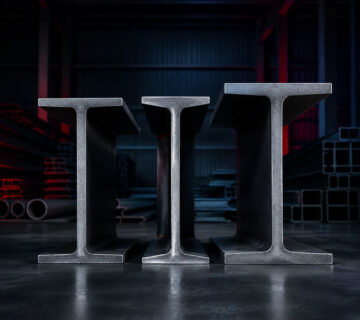
Manually calculating the weight of I-beams and channel sections is more complex than calculating that of plates or rebar, as their cross-sections involve varying thicknesses, curvatures, and the connection radius between the web and the flange. The best method for calculating the weight of these sections is to use the weight-per-unit-length value listed in the product’s technical table.





No comment