
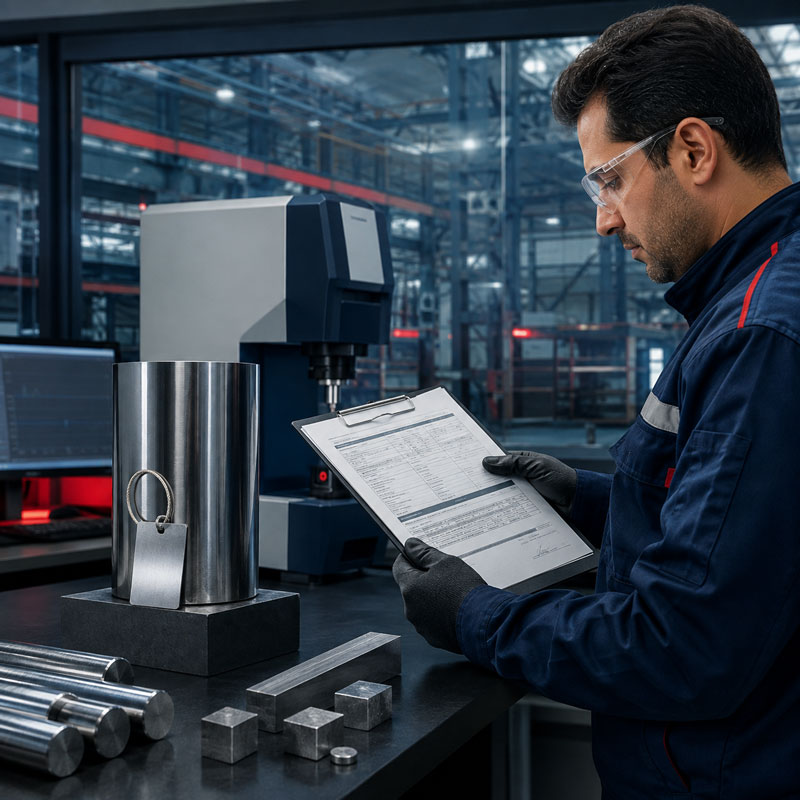
What Is a Steel Analysis Certificate? A Guide to Reviewing Steel Product Certificates
When purchasing steel products for construction, industrial, oil and gas, or equipment manufacturing projects, one cannot ensure product quality merely by looking at its appearance. Two steel sheets or sections may look identical yet differ significantly in chemical composition, strength, weldability, and mechanical behavior.
A key document for evaluating product specifications is the steel analysis certificate (or product certificate). This document provides information regarding the manufacturer, steel grade, heat number, mechanical test results, and chemical composition.
In this article, we examine what a steel analysis certificate is, what information it contains, and how to verify its authenticity and its correspondence to the specific shipment during purchase.
What Is a Steel Analysis Certificate?
A steel analysis certificate is a technical document issued by the manufacturer or an authorized body that outlines the specifications of a steel product or shipment. In the market, this document is also known by the following names:
Steel certificate
Product quality certificate
Inspection certificate
Analysis sheet
Mill Test Certificate (MTC)
Material Test Certificate
Mill Certificate
The primary purpose of this document is to enable product traceability and allow for the comparison of test results against relevant standards or order specifications.
The mere presence of an analysis sheet does not guarantee product quality. Details such as the heat number, dimensions, quantity, grade, and other certificate information must match the delivered product and the purchasing documentation.
Why Is Obtaining a Steel Certificate Important?
In many projects, selecting steel based solely on dimensions and weight is insufficient. A designer may have specified a particular grade with specific requirements for minimum yield strength, tensile strength, or welding conditions. Reviewing the product certificate is crucial for the following purposes:
Verifying the product’s compliance with order specifications
Identifying the actual steel grade
Reviewing mechanical test results
Checking the chemical composition
Tracing the product back to the specific melt or production batch
Preparing project quality control documentation
Assessing weldability
Submitting documentation to the client or supervisory body
Addressing potential discrepancies
In critical projects, the absence of a valid certificate can halt product approval or necessitate sampling and re-testing.
What is a Heat Number?
The heat number is one of the most important pieces of information listed on a steel certificate. This code identifies a specific production melt or batch and establishes a link between the physical product and its laboratory test results.
The heat number may be marked on the product itself, the bundle tag, the packaging label, or the shipment’s accompanying paperwork. Upon delivery, it must be verified that this number matches the heat number listed on the certificate.
If an order comprises multiple heat numbers, separate results or certificates may be provided for each section. Test results from one melt should not be generalized to the entire shipment without proper documentation.
What information is included in a steel analysis certificate?
Certificate formats vary depending on the manufacturer, product type, and applicable standards, but they typically include the following sections:
Manufacturer and Buyer Information
The top section of the certificate usually lists the mill name, quality control department, order number, buyer’s name, date of issue, and certificate number. This information helps identify the document and link it to the specific transaction. Product Specifications
This section may include the following details:
Product type
Steel grade
Manufacturing standard
Dimensions and thickness
Length or width
Number of pieces
Shipment weight
Delivery conditions
Order number
Heat number
The information in this section should be cross-checked against the invoice, bill of lading, product label, and original order.
Chemical Composition
The chemical analysis section lists the percentage of elements constituting the steel. Common elements include:
Carbon
Manganese
Silicon
Phosphorus
Sulfur
Chromium
Nickel
Molybdenum
Copper
The specific elements reported depend on the steel grade. For instance, controlling chromium and nickel levels is crucial for stainless steels, whereas the focus for certain structural steels is primarily on carbon, manganese, phosphorus, and sulfur.
Results must be compared against the permissible limits defined by the standard for that specific grade, rather than against a generic value applicable to all steels.
Mechanical Properties
This section indicates the steel’s performance in specific tests and may include:
Yield strength
Tensile strength
Percentage elongation
Hardness
Impact energy
Bend test results
For some products, mechanical properties vary with thickness; therefore, the thickness range and testing conditions must be taken into account when comparing results.
Heat Treatment Status
Some certificates specify delivery conditions or heat treatment processes—such as normalizing, quenching and tempering, annealing, or controlled rolling. This information is particularly important for alloy plates and industrial steels.
What is the difference between 3.1 and 3.2 certificates?
The EN 10204 standard defines the various types of inspection documents for metal products. Certificates 3.1 and 3.2 are among the most recognized documents under this standard.
Certificate 3.1
With a 3.1 certificate, the manufacturer declares that the product complies with order requirements and provides test results for the specific product or inspection batch. The document is validated by the manufacturer’s authorized inspection representative, who operates independently of the production department.
SSAB has also announced the availability of EN 10204-3.1 certification for its various steel product groups. Example of conditions for issuing a 3.1 certificate.
Certificate 3.2
For a 3.2 certificate, in addition to the manufacturer’s authorized representative, the purchaser’s representative or an inspector designated by official regulations also participates in validating the document. Consequently, this type of certificate is utilized in projects requiring a higher level of inspection. SSAB’s definitions of 3.1 and 3.2 certificates.
A request for a 3.2 certificate must be specified prior to purchase and production, as its preparation may require coordination…

No comment